Sunday, September 27, 2015

Lunar Radiance Bodhisattva


Lunar Radiance Bodhisattva
(Image: Original source unknown)

According to the Chinese Buddhist tradition, the Holy Day of Lunar Radiance Bodhisattva (月光菩薩 Yueguang Pusa) is observed on the 15th day of the 8th Chinese lunar month. 

The name of this bodhisattva comes from the Indian Sanskrit name Chandraprabha which means moonlight or lunar radiance. The full name of this bodhisattva in Chinese is Universal Illumination of Lunar Radiance Bodhisattva (月光遍照菩薩 Yueguang Bianzhao Pusa), but the name is sometimes just abbreviated as Lunar Radiance Bodhisattva (also translated as Moonlight Bodhisattva).


In his right hand, the Lunar Radiance Bodhisattva holds a lotus
that supports a white sphere with the character Moon (月 yue)
(Image: Original source unknown)

The observance of Lunar Radiance Bodhisattva’s holy day is on the same date as the Mid-Autumn Festival, because, without a doubt, the lunar theme of the former matches the theme of the full moon and the practice of lunar deity veneration that is associated with the latter.

The Lunar Radiance Bodhisattva and the Solar Radiance Bodhisattva are the two great bodhisattvas in the buddha realm (pure land) of Bhaisagyaguru, the Master of Healing Buddha (also known as the Medicine Buddha) (藥師佛 Yaoshi Fo).

Bhaisagyaguru, the Master of Healing Buddha (center),
Lunar Radiance Bodhisattva (left), Solar Radiance Bodhisattva (right)
(Image: Original source unknown)


From the Sutra of the Merits of the Fundamental Vows of Bhaisagyaguru Tathagata of Lapis Lazuli Crystal Radiance (藥師琉璃光如來本願功德經 Yaoshi Liuli Guang Rulai Benyuan Gongde Jing) (Taisho Tripitaka, Vol. 14, No. 450), the buddha realm of Bhaisagyaguru is described as follows:

In this land, the ground is made of lapis lazuli, the boundaries are demarcated with golden cords, the towns, towers, palaces, pavilions, as well as the balconies, windows and draperies are all made of the Seven Treasures. The merits, virtues and adornments of this realm are identical to those of Amitabha Buddha’s Pure Land in the west.

In this land dwell two great bodhisattvas, Universal Solar Radiance and Universal Lunar Radiance. Among the countless bodhisattvas, they are the leaders. Each in turn will serve as successor to the Medicine Buddha and as the able guardian of His True Dharma treasury.

[Source: Sutra of the Medicine Buddha─Translated & Annotated under the Guidance of Dharma Master Hsuan Jung by Minh Thanh & P.D. Leigh]


Lunar Radiance Bodhisattva
(Image: Original source unknown)

From the Dharanis of Solar Radiance Bodhisattva and Lunar Radiance Bodhisattva (日光菩薩月光菩薩陀羅尼 Riguang Pusa Yueguang Pusa Tuoluoni) (Taisho Tripitaka, Vol. 20, No. 1160), the mantra of Lunar Radiance Bodhisattva is given as follows:

深低帝屠蘇
阿若蜜帝烏都
深耆
波賴帝
耶彌若吒烏都吒
拘羅帝吒耆摩吒
娑婆訶

Shēn dī dì tú sū zhà
Ā ruò mì dì wū dū zhà
Shēn qí zhà
Bō lài dì zhà
Yē mí ruò zhà wū dū zhà
Jū luó dì zhà qí mó zhà
Suō pó hē
[Chinese Mandarin transliterated from Indian Sanskrit, romanized using Hanyu Pinyin]


Homage to Chandraprabha, the Bodhisattva of Lunar Radiance!


Text © 2015 Harry Leong

Tuesday, August 18, 2015

The Qixi Festival

The Cowherd and Weaver Maiden
(Image: Original source unknown)

The Qixi Festival (七夕節 Qixi Jie) is celebrated on the 7th day of the 7th Chinese lunar month. Qixi (七夕) means The Night of Sevens. It is usually translated into English as the Double Seventh Festival.

This festival is also known by other alternate names including Festival to Plead for Skills (乞巧節 Qiqiao Jie), Anniversary of the Seventh Sister (七姐誕 Qijie Dan), Daughter’s Festival (女兒節 Nu’er Jie), and Magpie Festival (喜鵲節 Xique Jie).


The origin of this festival comes from the story of the Cowherd and Weaver Maiden (牛郎織女 Niulang Zhinu) and is connected with Chinese astronomy. This story is one of the Four Great Folk Legends of China (中國四大民間傳說 Zhongguo Sida Minjian Chuanshuo) and there are many versions of it, but the basic tale is about the star-crossed love between a celestial maiden and a mortal man who tended cows. The Weaver Maiden was a daughter of the Jade Emperor (玉皇大帝 Yuwang Dadi) and his wife, the Queen Mother of the West (西王母 Xiwang Mu), and the youngest of seven sisters (hence the alternate names, Anniversary of the Seventh Sister and Daughter’s Festival). As a heavenly being, her job was to weave beautiful colored clouds in the skies with her ethereal silk. 

Multi-colored clouds
(Image: Original source unknown)

Once, on a trip to the mortal world, she fell in love and married a cowherd with whom she had two children. When the Queen Mother of the West learned that her daughter had married a lowly mortal man, she became angry and ordered that her daughter be brought back to the heavenly regions. As the Weaver Maiden was forcibly taken into custody by heavenly guards, the Cowherd used a magical oxhide to fly up to the skies with his two children to pursue his wife.

Heavenly guards take the Weaver Maiden into custody as the Cowherd gives chase
(Image: Original source unknown)

As the Cowherd nearly caught up with the Waiver Maiden, the Queen Mother of the West separated them by creating a huge river between them. They helplessly cried out for each other as they were divided to opposite sides of the great expanse.

The Cowherd and Weaver Maiden become separated by the Silver River (Milky Way)
(Image: Original source unknown)

But after time, the Queen Mother of the West became more sympathetic, and finally decided to allow them to meet once per year. So each year on the 7th day of the 7th lunar month, countless magpies of the world would form a bridge over the river (hence the alternate name, Magpie Festival) so that the Cowherd, Weaver Maiden, and their two children could be reunited.

A bridge is formed by magpies over the Milky Way to reunite the star-crossed lovers
(Image: Original source unknown)

The Cowherd and Weaver Maiden are reunited for just one night
(Image: Original source unknown)

The Cowherd, Weaver Maiden, and their two children are joyfully reunited
(Image: Hillfox Art Series)

In some versions of the story, it is the Jade Emperor instead of the Queen Mother of the West that forbids their liaison.

The earliest known reference to this mythical tale is found in the Classic of Poetry (詩經 Shi Jing), also known as the Book of Songs, which is a collection of poetry dating from the 11th to 7th centuries BCE. The festival itself has been celebrated as early as the 2nd century BCE during the Han dynasty. The numerical significance of the lunar date 7/7 is based on the family position of the Weaver Girl as being the seventh daughter/sister. Because of the sincere love expressed in this tale, the festival is also informally known in modern times as Chinese Valentine’s Day (中國愛情節 Zhongguo Aiqing Jie).

If we study the night sky, the Cowherd is represented by the star Altair which is the brightest star in the constellation Aquila and the twelfth brightest star in the night sky. Its name in Chinese astronomy is Hegu Er (河鼓二) which means Second Star of the River Drum. It is also popularly called the Cowherd Star (牛郎星 Niulang Xing).

The Weaver Maiden is represented by the star Vega which is the brightest star in the constellation Lyra and the fifth brightest star in the night sky. Its name in Chinese astronomy is Zhinu Yi (織女一) which means First Star of the Weaver Maiden.

Altair (Cowherd) and Vega (Weaver Maiden)
(Image: Original source unknown, modified by Harry Leong)

Their two children are represented by the stars Alshain (Beta Aquilae) and Tarazed (Gamma Aquilae). Alshain is a star in the constellation Aquila and its name in Chinese astronomy is Hegu Yi (河鼓一) which means First Star of the River Drum. Tarazed is also located in the constellation Aquila and its Chinese astronomical name is Hegu San (河鼓三) which means Third Star of the River Drum. These two stars flank Altair, the Cowherd Star, like children standing by their father.

Alshain and Tarazed are children who stand on both sides of their father, Altair (Cowherd)
(Image: Original source unknown, modified by Harry Leong)

The river that separates the Cowherd and the Weaver Maiden is represented by the Milky Way galaxy that appears as a glowing band arching across the night sky. In Chinese astronomy, the Milky Way is called the Silver River (銀河 Yin He) or the Heavenly River (天河 Tian He).

The Silver River is represented by the Milky Way, a wide band of stars and dust clouds
(Image: Original source unknown)

In ancient China, there are many traditional activities on the day of the Qixi Festival. These activities mainly involve single young women and vary by region. The following list is by no means exhaustive, but includes many of the more well-known customs:

• Needlework competitions – Young women engage in competitions of threading needles, especially under the moon in low light conditions. The theme of weaving and needlework is based on several aspects of the festival: the Weaver Maiden’s celestial weaving skills; the festival takes place during the early autumn when women start to make warmer clothes for the coming winter; the festival celebrates romance and marriage, so single women looking for a good spouse must show off their talents in needlework which was an important domestic skill for women in pre-modern times.

• Handicrafts and paper-cutting activities – Young woman partake in creating handicrafts and paper-cutting games to show dexterity and skill because dexterous and nimble hands were an important traditional asset of women in pre-modern times.

• Fruit carving activities – Young women engage in fruit carving activities to show dexterous and skillful hands, an important traditional trait of women in pre-modern times. Fruit can be carved into the shapes of animals or flowers, or relief patterns carved into the fruit skins.

• Placing a needle in a water bowl – Girls play a game where they put a needle on the surface of a bowl of water, and if the needle does not sink due to water surface tension, the girl is said to be mature enough to find a spouse. They also observe the shadow of the needle appearing at the bottom of the bowl. If the shadow moves like floating clouds, it means that the girl is gaining skill and dexterity.

• Making prayers to the Weaver Maiden – At makeshift shrines under the evening sky, young women make offerings of incense, flowers, fruits, and feminine vanity items like combs, mirrors, and cosmetics to pray for beauty, intelligence, a good spouse, and acquiring the traditional skills of a good wife (hence the alternate name, Festival to Plead for Skills). An auspicious sign was a spider weaving its web on anything on the shrine which was taken to mean that the Weaver Maiden is responding to the prayers. 

• Keeping a spider in a box – Spiders, who are natural weavers, are caught and placed into boxes and kept overnight. The box is opened the next morning, and if the spider had weaved a cobweb inside the box, it means that the Weaver Maiden will bless the young woman with intelligence and skills. Also, the denser the cobweb, the more skill the woman will have.

• Hair Washing – Girls wash their hair with water from springs or rivers on the day of the Qixi Festival because it was believed that the water had special qualities on this day to bestow beauty and intelligence.

• Collecting dew water in basins – Girls collect dew water in a basin on the day of the festival because dew water represented the joyful tears of the reunited Cowherd and Weaver Maiden. Applying the dew water to one’s eyes and hands bestowed intelligence and skill.

• Planting seedlings using rice or beans

• Celebrating the life of oxen – Children hang flowers on oxen horns to honor the ox whose hide was used by the Cowherd to fly to heaven.

• Standing under a fruit vine – It was said that if one stood under a fruit vine on the night of the Qixi Festival, one could hear the whispering of conversation between the Cowherd and Weaver Maiden in the heavens above.  

• Stargazing under the night sky to look at the Altair and Vega stars


A girl threads a row of seven needles in a needlework competition
(Image: News.cn)

A girl threads a needle under the evening sky
(Image: Original source unknown)

Cartoon illustration of a young woman praying to the Weaver Maiden Star
(Image: Feng Yincheng/Xinhua News Agency 馮印澄/新華社發)

Evening prayer ritual to the Weaver Maiden being performed at a temple
(Image: thnet.gov.cn)

Qixi Festival games such as keeping a spider in a box, and placing a needle in a water bowl
(Image: Original source unknown)

Stargazing on the evening of the Qixi Festival
(Image: Kagaya/Hoshinavi.com)

Some, or most of these traditional activities are no longer practiced in contemporary China, but the festival is still widely celebrated by couples in a manner very similar to the Valentine’s Day of Western culture. For example, young people nowadays celebrate the festival with a romantic dinner, flowers, and chocolates.  

In Hong Kong, on the day of the festival, young women and couples visit Lovers’ Rock (姻緣石 Yinyuan Shi) on Bowen Road in Wanchai to burn incense and lay offerings at the rock to ask for romance and/or a happy marriage.

A couple prays at the Lovers’ Rock in Hong Kong
(Image: Orientaldaily.on.cc)

Traditional foods during the Qixi Festival include:

• Dexterity snacks (巧果 Qiaoguo, literally skillful fruit) - fried thin pastries made from flour, oil, sugar, and honey

Chinese chestnuts (蘋婆Pingpo Guo), also called Phoenix Eye Fruit (鳳眼果 Fengyan Guo) or Seventh Sister’s Fruit (七姐果 Qijie Guo)

• Noodles, dumplings, wontons

Fried snacks called Qiaoguo (巧果)
(Image: Babyhome.com)
Chinese Chestnuts, also known as Phoenix Eye Fruit and Seventh Sister’s Fruit
(Image: Original source unknown)

The cultural significance of the Qixi Festival is important due to several principles that are also relevant to modern times:

• The eternal love between the Cowherd and Weaver Maiden reminds us about the importance of devotion and responsibility in marriage and romantic relationships

Pleading for skills should be seen as encouragement for females to continuously learn and develop intellect and skills (not just domestic skills)

• The role and importance of women in society should be respected

A Chinese ink painting of the Cowherd and Weaver Maiden with poetic verses
(Image: Original source unknown)

The Qixi Festival is the forerunner to the Japanese Tanabata Festival (Star Festival) and the Korean Chilseok Festival that are based on a similar myth and background.


Text © 2015 Harry Leong

Friday, December 30, 2011

Laba Festival

The Laba Festival (臘八節 Laba Jie) is a traditional festival celebrated on the 8th day of the 12th Chinese lunar month. La () in Chinese refers to the last month of the year, also known as the La Month (臘月 La Yue); and ba () refers to the eighth day. According to one popular theory, the festival originally began as a celebration and thanksgiving of the new harvest, but after Buddhism was transmitted from India to China in the first century CE, it was merged with the celebration of Lord Buddha’s Enlightenment Day (佛陀成道日 Fotuo Chengdao Ri) which is believed by Chinese Buddhists to be on that date (the date observed in Chinese Buddhism as the day of Lord Buddha’s enlightenment is lunar date 12/8, while many other Buddhist traditions generally observe the Buddha’s enlightenment as a part of the Vesak Festival in the fourth lunar month).

Laba Porridge
(Image: Meishichina.com)

A traditional food eaten on the day of the Laba Festival is Laba porridge (臘八粥 Laba Zhou) which is made from a combination of glutinous rice and many different kinds of grains, cereals, beans, dried fruits, and nuts that may include - but are not limited to - millet, lotus seeds, melon seeds, jujube dates, longan (dragon’s eye fruit), Job’s tear grains, red beans, peas, gingko nuts, chestnuts, walnuts, almonds, pine nuts, and peanuts.

Grains and beans used for Laba porridge
(Image: Nipic.com)

The porridge can be made sweet or savory by adding sugar or salt depending on regional preferences. Other condiments like cinnamon can also be added for additional flavor. Laba porridge is also sometimes called Eight Treasures porridge (八寶粥 Babao Zhou) because it is sometimes made from a traditional list of eight kinds of ingredients.

The eight different kinds of ingredients plus rice for Eight Treasures porridge
(Image: Source unknown)

A family prepares Laba porridge for the festival
(Image: Source unknown)

There are several explanations about the origin of Laba porridge. One explanation is that after the autumn harvest, porridge made from the harvested food ingredients is made and offered in thanksgiving to the heavenly deities and/or ancestors. Another explanation is that it was both a celebration of the harvest and a form of nutritious food for people in winter time because the porridge is a healthy mixture of many wholesome ingredients.

Laba porridge is a health food
(Image: Source unknown)

Another explanation connected with the Chinese Buddhist tradition says that Laba porridge is eaten to commemorate Lord Buddha’s enlightenment because while undergoing ascetic practices, the Buddha eventually realized that extreme forms of asceticism did not promote spiritual awakening, so he abandoned them and accepted a rice porridge offered to him by a young maiden. The porridge helped him regain his physical strength and he later found supreme enlightenment. That is why Laba porridge is also called Buddha’s porridge (佛粥 Fo Zhou) (however, the porridge that the Buddha ate did not have so many ingredients, because according to the original Indian Buddhist story, the Buddha ate only a porridge made of milk and rice). In all probability, the earlier practice of cooking porridge as a post-harvest custom was merged with the commemoration of the Buddha’s enlightenment that came to be observed in China later on.

Because the offering of the rice porridge helped Lord Buddha continue on the path to find spiritual awakening, it became the food symbolic of the quest for enlightenment.

The Buddha became emaciated and weak from practicing austerities.
He later abandoned them because they did not lead to spiritual enlightenment.
(Image: Source unknown)

The maiden Sujata offered a bowl of milk rice porridge to the Buddha
which restored his strength after he became weak from practicing austerities
(Image: Source unknown)

After restoring his health, the Buddha attained supreme enlightenment
(Image: Source unknown)

Buddhist monks in China serve Laba porridge to the public
(Image: Chinanews.com)

Aside from eating Laba porridge, religious activities during the Laba Festival usually include ceremonies for honoring Lord Buddha (Shakyamuni), and prayers and rites for good health and blessings.

Laba Festival cartoon drawing
(Image: 5liao.cc)

May everyone have a happy Laba Festival!


Text © 2011 Harry Leong

Sunday, December 11, 2011

Amitabha Buddha

Amitabha Buddha
(Image: Source unknown)

According to the Chinese Buddhist tradition, the 17th day of the 11th Chinese lunar month is observed as the Holy Day of Amitabha Buddha (阿彌陀佛聖誕 Amituofo Shengdan).

Amitabha (阿彌陀佛 Amituofo) is one of the great transcendent buddhas of Mahayana Buddhism. His name, Amitabha, is a Sanskrit name that means Buddha of Infinite Light (無量光佛 Wuliangguang Fo). This buddha is also known as Amitayus (無量壽佛 Wuliangshou Fo) which means Buddha of Infinite Life. He is also known as The Tathagata King of Ambrosia (甘露王如來 Ganluwang Rulai) where ambrosia is a metaphor for bringing relief and salvation and the assuaging of pain and suffering, and Tathagata is another title for a buddha which has many layers of meaning.

The historical buddha (Shakyamuni) taught about Amitabha/Amitayus in three principal texts:
1) The Longer Sukhavati-vyuha Sutra, also known as the Sutra Spoken by the Buddha on Amitayus (佛說無量壽經 Foshuo Wuliangshou Jing), known colloquially as the Amitayus Sutra (無量壽經 Wuliangshou Jing) (Taisho Tripitaka T12 No. 360)
2) The Shorter Sukhavati-vyuha Sutra, also known as the Sutra Spoken by the Buddha on Amitabha (阿彌陀經 Foshuo Amituo Jing), known colloquially as the Amitabha Sutra (阿彌陀經 Amituo Jing) (Taisho Tripitaka T12 No. 366)   
3) The Amitayur-dhyana Sutra, also known as the Sutra Spoken by the Buddha on the Visualization of Amitayus (說觀無量壽佛經 Foshuo Guan Wuliangshoufo Jing), known colloquially as the Visualization of Amitayus Sutra (觀無量壽經 Guan Wuliangshou Jing) (Taisho Tripitaka T12 No. 365)

According to these texts, Amitabha had attained supreme enlightenment ten aeons ago in a remote period of antiquity. He is a trans-historical buddha (the concept of trans-historical buddhas was discussed in the previous post which can be found here). He was a king who renounced his land to become a monk so that he could pursue spiritual cultivation. His religious name was Dharmakara (法藏 Fazang) which means Treasury of the Buddhist Teachings. He was taught by Lokesvaraja Buddha who lived during that time, and he subsequently made forty-eight great vows to rescue and deliver living beings.

The majestic countenance and form of Amitabha Buddha
(Image: Source unknown)

Of the forty-eight great vows, the eighteenth vow states:

When I attain Buddhahood, if there should be any sentient beings in the ten directions who desire to be reborn in my land with confidence and joy, and if they bring forth to mind this resolve even just ten times but fail to achieve rebirth there, then may I not obtain perfect enlightenment. This excludes those that have committed the five serious crimes or those that have slandered the True Dharma.

設我得佛,十方眾生至心信樂欲生我國,乃至十念,若不生者,不取正覺,唯除五逆、誹謗正法.

This vow is the most noteworthy because it forms the foundational basis and principal objective of the Pure Land School (淨土宗 Jingtu Zong) of Mahayana Buddhism which is to achieve rebirth in Sukhavati (極樂世界 Jile Shijie; the Realm of Ultimate Joy), the name of the pure land of Amitabha Buddha.


Sukhavati: the Realm of Ultimate Joy
(Image: Source unknown)

A pure land or pure realm (淨土 jingtu), also called a buddha land or buddha realm (佛土 fotu; buddha-ksetra), is a spiritual world created by an enlightened being for the purpose of saving and delivering sentient beings. The genesis of a pure realm starts with a wish when a bodhisattva (i.e. future buddha) brings forth a great resolve from his mind and makes a vow to establish a pure realm; and then upon achieving enlightenment, the force and power of that resolve causes the vow to become a reality. Pure realms are always beautiful and magnificently adorned, but it must be emphasized that they are not the same as heavens (as sometimes misunderstood or erroneously assumed to be). Although the descriptions of pure realms may at first seem to share similar superficial characteristics with the heaven realms, there are big differences between the two.

According to Buddhist cosmology, the heavens are still within samsara - the endless cycle of transmigration that ordinary unenlightened beings are trapped in. Ordinary beings are bound by the results of the karma that they themselves continuously create, so they are repeatedly reincarnated in one of the six paths of samsaric existence, until they can free themselves by winning enlightenment through spiritual practice. The heavens are considered one of the six paths of samsaric existence, along with the other paths of ashuras (demons or power-seeking deities), humans, animals, hungry spirits (pretas), and hell. And as it is true for all the other samsaric states, existence in heaven is transitory and not eternal. And even though the lifespan of a heavenly being is extremely long, it is still finite because heavenly life ends when one’s accumulation of karmic merit is exhausted. Rebirth in the heaven realms is a karmic reward for past virtuous actions, but it is certainly not a goal of Buddhist practice because of two reasons. First, because heaven is still a part of samsaric existence, it has nothing to do with the goal of Buddhist practice which is to escape from samsara. Second, life in heaven does not necessarily further one’s own spiritual progress, because the bliss and pleasures of heaven are too enchanting and disruptive for spiritual cultivation.

In contrast, pure realms are spiritual worlds that exist outside of samsara because they are created by the power of fully enlightened buddhas. They serve as expedient places to continue spiritual practice under the guidance of the buddha that presides over that pure realm. The environments of pure realms are devoid of worldly distractions and are perfectly supportive and conducive to spiritual cultivation and progress. Pure realms are created out of skillful expedient means by the buddhas to help sentient beings achieve liberation more quickly by escaping samsara sooner so that they can be brought closer to attaining final enlightenment. In the Mahayana Pure Land tradition, it is believed that progressing towards enlightenment through rebirth in a buddha’s pure realm is preferable to striving towards enlightenment by solely depending on one’s own self-efforts because self-effort alone is very difficult and takes many aeons and lifetimes. A metaphor for the pure land method is called Horizontal Escape from the Three Realms [of Samsara] (橫出三界 Hengchu Sanjie). Here, the Three Realms [of Samsara] refer to the Realm of Desire (欲界 Yujie), the Realm of Form (色界 Shijie), and the Realm of Formlessness (無色界 Wushijie). The metaphor paints the picture of a worm that is trapped inside the middle of a stalk. To escape from the stalk, the worm has to crawl the length of the stalk to get out at either end. But a quicker way out would be to bore a hole in the stalk and just exit sideways. In the analogy, the worm represents the spiritual cultivator, the stalk represents samsara, and traversing the length of the stalk represents the long way of escaping samsara through self-effort alone, while boring a hole in the stalk and exiting sideways represents the short way of escaping samsara by taking advantage of the Pure Land method. In Pure Land Buddhist parlance, spiritual practice relying on self-effort alone is called self-power (自力 zi li), while spiritual practice using the Pure Land method is a combination of both self-power and other-power (他力 ta li) because in addition to exerting one’s own efforts, one also takes advantage of Amitabha’s vows to help living beings achieve spiritual liberation.

The enlightened master Venerable Hsu Yun (虛雲 Xuyun) (1840-1959)
practicing recitation of the holy name of Amitabha Buddha
(Image: Source unknown)

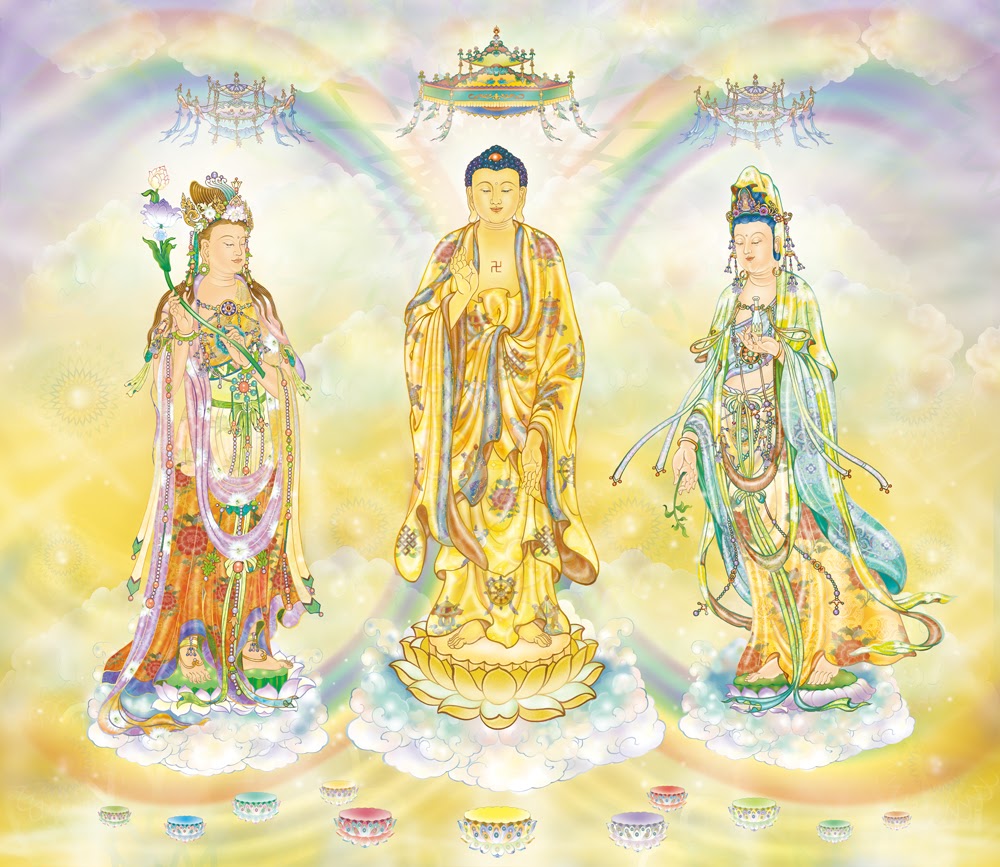
The main practice of the Pure Land school is buddha remembrance (念佛 nianfo) which is to constantly focus one’s attention and mindfulness on Amitabha either through oral recitation of his holy name (or his mantra in the esoteric schools), reading and chanting his scriptures, or visualization on the characteristics of his physical form and his pure realm. These practices, when combined with sincerity of faith and a strong aspiration to be reborn in Amitabha’s pure realm, will result in Amitabha Buddha and his two bodhisattvas Avalokiteshvara (觀世音 Guanshiyin) and Mahasthamaprapta (大勢至 Dashizhi) coming to welcome and lead (接引 jieyin) the pure land practitioner to the realm of Sukhavati at the end of his natural life. There, he will be able to listen to the Buddhist teachings as spoken directly by Amitabha, and spiritual progress in the pure realm will be swift, because even all the sights and sounds in the pure realm magically proclaim the Buddhist teachings.

The Three Holy Ones of Sukhavati
Amitabha Buddha (center), Bodhisattva Avalokiteshvara (right), Bodhisattva Mahasthamaprapta (left)
(Image: Venerable Master Yilin 依林法師)

A depiction of Amitabha and his holy entourage coming to
welcome and lead the pure land practitioner to Sukhavati
(Image: Source unknown)

Even though there are many buddhas and pure realms in the Mahayana Buddhist tradition, the vast majority of its practitioners aspire to be reborn in Amitabha’s pure realm because Amitabha occupies a unique place in the hearts and minds of Mahayana Buddhist followers.

Chinese calligraphy: Namo Amituofo
The meaning is I take refuge in Amitabha Buddha.
(Image: Source unknown)

Homage to Amitabha, the Buddha of Infinite Light.


Text © 2011 Harry Leong